
Business Days Calculator – Count Working Days
Calculate the exact number of working days between two dates, excluding weekends and official United States federal holidays with legal observed date rules.
Understanding US Business Days & Working Day Calculations
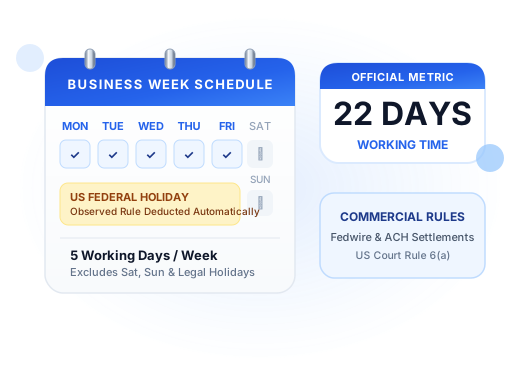
In the United States, commercial contracts, financial banking settlements, legal court filings, government agencies, and shipping carriers operate on business days rather than calendar days. A contractual “10 business day” deadline spans more than two weeks on a conventional calendar. Using our business days calculator and business day counter ensures you never miscalculate a critical working-day window.
Calendar Days vs. Business Days: The Key Differences
The distinction between calendar days and working business days is fundamental:
- Calendar Days: Every consecutive 24-hour day, including Saturdays, Sundays, and statutory public holidays.
- Business Days: Mondays through Fridays only, strictly omitting weekend days and recognized federal holidays.
Official US Federal Holidays & Observed Date Rules (5 U.S.C. 6103)
Under United States federal law (5 U.S.C. 6103), eleven annual public holidays are recognized. When a federal holiday falls on a weekend, federal agencies and financial institutions observe it on an adjacent weekday:
- Saturday Holidays: Observed on the preceding Friday.
- Sunday Holidays: Observed on the following Monday.
| Federal Holiday | Statutory Rule | Observation Convention |
|---|---|---|
| New Year’s Day | January 1 | Preceding Friday if Sat; Following Monday if Sun |
| Martin Luther King Jr. Day | Third Monday in January | Always a Monday |
| Washington’s Birthday (Presidents’ Day) | Third Monday in February | Always a Monday |
| Memorial Day | Last Monday in May | Always a Monday |
| Juneteenth National Independence Day | June 19 | Preceding Friday if Sat; Following Monday if Sun |
| Independence Day (4th of July) | July 4 | Preceding Friday if Sat; Following Monday if Sun |
| Labor Day | First Monday in September | Always a Monday |
| Columbus Day / Indigenous Peoples’ Day | Second Monday in October | Always a Monday |
| Veterans Day | November 11 | Preceding Friday if Sat; Following Monday if Sun |
| Thanksgiving Day | Fourth Thursday in November | Always a Thursday |
| Christmas Day | December 25 | Preceding Friday if Sat; Following Monday if Sun |
Important Limitations for Court & Legal Deadlines
In legal litigation, Federal Rule of Civil Procedure 6(a) governs the computation of time for federal court filings. While FRCP 6(a) excludes Saturdays, Sundays, and legal public holidays for specific short-deadline computations, state court procedural rules and commercial arbitration clauses may define non-working days differently.
Related Tools and In-Depth Guides
Learn more about working day schedules and date calculation conventions:
Guide: Calendar vs Business Days
Comprehensive legal and commercial breakdown of working day counting rules.
Date Calculator (+/- Days)
Add a specific number of working days to any date to find delivery or completion dates.
Days Between Dates Calculator
Measure total calendar days without holiday or weekend exclusions.
Days Until Calculator
Count down calendar days remaining until deadlines or holidays.
Business Days Calculator FAQ
Yes. All weekend days (Saturdays and Sundays) within your selected date interval are automatically excluded from the business day count.
In accordance with 5 U.S.C. 6103, federal holidays falling on Saturday are observed on Friday. If that Friday falls within your calculation range, it is deducted as a non-working holiday.
Yes. Check the “Include End Date” box to include the final date if it is an eligible Monday-through-Friday working day.
Our tool strictly models the 11 statutory US federal holidays. Individual state holidays (such as Patriots’ Day in Massachusetts or Texas Independence Day) should be verified locally.